


When Will FIFA World Cup 2026 Start? Full Schedule, Teams & Host Countries
The countdown to the biggest football tournament in history is now underway, with the FIFA World Cup 2026 start officially set for June 11, 2026. And the world’s most-watched sporting event is about to get a complete makeover. Three host nations. Forty-eight competing teams. One hundred and four matches. Thirty-nine days of football that will rewrite the record books before the final whistle even blows.
Squads are being named this week. Lionel Messi was included in Argentina’s initial roster on May 11. Bosnia and Herzegovina became the first nation to announce their full squad on the same day. The machine is in motion, and June 11 is closing in fast.
Also Read: US Captain Confident Ahead of 2026 FIFA World Cup Draw
Here is everything fans globally need to know about the FIFA World Cup 2026 start, the complete schedule, qualified teams and the three countries hosting it all.
When Does FIFA World Cup 2026 Start?
The FIFA World Cup 2026 starts on Thursday, June 11, 2026. The opening match is scheduled at Estadio Azteca in Mexico City, where hosts Mexico take on South Africa in Group A.
It is a venue that carries enormous historical weight. The Azteca previously hosted World Cup matches in 1970 and 1986 — making it the first stadium ever to feature in three separate FIFA World Cups. Diego Maradona scored both the “Hand of God” and the “Goal of the Century” on that same pitch in 1986. Forty years later, the world’s cameras return.
The tournament concludes with the final on Sunday, July 19, 2026, at MetLife Stadium in East Rutherford, New Jersey — officially renamed the New York New Jersey Stadium by FIFA for the duration of the competition.
That is 39 days of football in total, making this the longest men’s World Cup ever staged, surpassing the 32-day editions of 2014 and 2018.
Full Stage-by-Stage Schedule
| Stage | Dates |
|---|---|
| Group Stage | June 11 – June 27 |
| Round of 32 | June 28 – July 3 |
| Round of 16 | July 4 – July 7 |
| Quarter-finals | July 9 – July 11 |
| Semi-finals | July 14 – July 15 |
| Third-Place Match | July 18 |
| Final | July 19, 2026 |
According to FIFA’s official tournament regulations, clubs must release players named in final squads by May 25, with exceptions granted to those involved in continental club finals up to May 30. All 48 national teams must submit their final 26-man squads to FIFA by June 2, when they will be officially published.
Three Host Countries: USA, Mexico and Canada
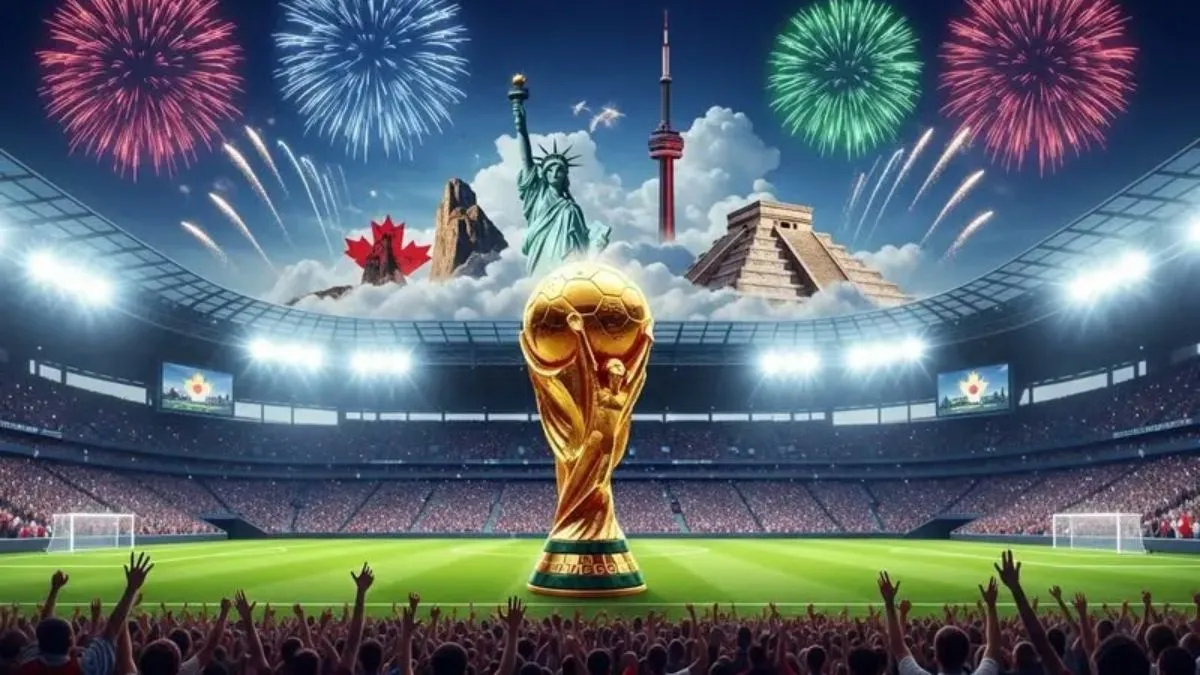
For the first time in the tournament’s 96-year history, three nations are co-hosting the FIFA World Cup simultaneously. The United States, Mexico and Canada form the joint hosting partnership — a continental arrangement that spans thousands of miles and multiple time zones.
The only previous co-hosted World Cup was the 2002 edition shared by South Korea and Japan. That involved two neighboring countries. This one crosses an entire continent.
United States — 11 host cities: Atlanta, Boston, Dallas, Houston, Kansas City, Los Angeles, Miami, New York/New Jersey, Philadelphia, San Francisco Bay Area and Seattle.
Mexico — 3 host cities: Mexico City, Guadalajara and Monterrey.
Canada — 2 host cities: Toronto and Vancouver.
The United States hosts the heavyweight end of the draw. All quarter-finals, both semi-finals and the final take place on American soil. Dallas Stadium — AT&T Stadium, renamed for the tournament — hosts nine matches including a semi-final. Los Angeles Stadium hosts eight, including the USA’s group opener.
Mexico earns a unique distinction through this tournament: it becomes the only country in history to host or co-host the men’s World Cup three times, having previously done so in 1970 and 1986. For Canada, whose men’s team missed the World Cup entirely between 1986 and their Qatar 2022 return, competing at home carries a significance that goes beyond football.
Also Read: Powerful Reveal FIFA World Cup 2026 Mascots Unveiled
All 48 Qualified Teams
The full 48-team field was locked in on March 31, 2026, following the conclusion of all intercontinental playoff matches — the longest and most geographically extensive qualifying campaign in World Cup history.
Europe — 16 teams: England, France, Germany, Spain, Portugal, Netherlands, Belgium, Austria, Croatia, Switzerland, Norway, Scotland, Sweden, Bosnia and Herzegovina, Türkiye, Czechia.
South America — 6 teams: Argentina (defending champions), Brazil, Uruguay, Colombia, Ecuador, Paraguay.
Africa — 10 teams: Morocco, Tunisia, Egypt, Algeria, Ghana, Cape Verde, South Africa, Ivory Coast, Senegal, DR Congo (via intercontinental playoff).
Asia — 8 teams: Japan, South Korea, Iran, Australia, Qatar, Saudi Arabia, Jordan, Uzbekistan.
CONCACAF — 6 teams: USA, Mexico, Canada, Haiti and additional qualifiers.
Oceania — 1 team: New Zealand, making history as the first Oceanian nation guaranteed a World Cup place without needing an intercontinental playoff.
Iraq secured their place through the intercontinental playoffs, defeating Bolivia 2-1 in the final playoff match to end a 40-year absence from the tournament.
The Biggest Absence: Italy
The standout missing name is Italy. The four-time world champions have failed to qualify for a third straight World Cup — a sustained collapse that is without precedent for a nation of Italy’s stature. Their last appearance was Brazil 2014. The 2006 winners are watching from home again.
Poland, Romania, Northern Ireland and Albania also failed to reach the tournament.
Four Nations Debut on the World Stage
Four countries will appear at a men’s World Cup for the very first time:
- Cape Verde — topped their African qualifying group ahead of Cameroon
- Curaçao — with a population of roughly 156,000, they are the smallest nation by population and land area ever to qualify for a World Cup
- Jordan — qualified through the Asian pathway
- Uzbekistan — came through Asia’s fiercely competitive 47-nation process
Title Favourites
Eight former world champions are in the field. Based on FIFA’s April 2026 rankings, the top five entering the tournament are France (1st), Spain (2nd), Argentina (3rd), England (4th) and Portugal (5th). Brazil sit sixth.
Argentina arrive as defending champions, with Lionel Messi — now 38 years old and named in his country’s preliminary squad on May 11 — widely expected to play his sixth and likely final World Cup. He needs three more goals to break the all-time World Cup scoring record.
A record eight Arab nations have qualified in a single tournament: Algeria, Egypt, Iraq, Jordan, Morocco, Qatar, Saudi Arabia and Tunisia.
Opening Ceremonies: Who’s Performing
All three host nations are staging opening ceremonies tied to their first matches.
In Mexico City on June 11, Colombian reggaeton star J Balvin and South African singer Tyla will perform at Estadio Azteca before Mexico vs South Africa kicks off.
In Toronto on June 12, Canadian icons Michael Bublé and Alanis Morissette headline at BMO Field before Canada face Bosnia and Herzegovina.
At Los Angeles Stadium on June 12 evening, pop star Katy Perry and rapper Future perform ahead of USA vs Paraguay.
Why the FIFA World Cup 2026 Start Matters Globally
This is not simply the largest World Cup by team count. It represents a structural shift in how international football operates.
Africa’s allocation has doubled from five teams in Qatar 2022 to nine this time around. Asia goes from six to eight. These numbers reflect both the sport’s genuine commercial expansion into new markets and — more importantly — the real improvement in football quality outside Europe and South America.
For the United States, the FIFA World Cup 2026 start marks the country’s first home tournament since 1994. That edition transformed American football, leading directly to the birth of Major League Soccer. Thirty-two years on, the landscape looks entirely different. American players now compete at Europe’s top clubs. The domestic game has professional depth it never had before. This time, the USA arrives as a host with genuine expectations on the pitch, not just in the boardroom.
Economically, the stakes are enormous. The tournament is projected to generate tens of billions of dollars across the three host nations through tourism, broadcasting rights and sponsorship. Dallas alone has received $32 million in federal security funding. Cities across the continent have spent years preparing infrastructure, fan zones and transport networks.
For fans unable to travel, FIFA is operating free official Fan Fests in every host city — open-air public viewing events with giant screens covering every match.
In the United States, all 104 matches air on Fox and FS1, with full streaming through the Fox Sports app.
Conclusion: The FIFA World Cup 2026 Start Is Days Away
The FIFA World Cup 2026 start on June 11 is no longer a distant date on a calendar. Squads are being finalised this week. Stadiums are ready. Three nations — and billions of fans worldwide — are prepared.
From Estadio Azteca in Mexico City to MetLife Stadium in New Jersey, the tournament spans a continent and a record 39 days. Four nations will play in their first-ever World Cup. Italy will watch from home for the third time running. Messi chases history. And somewhere in the draw, an underdog is preparing a story no one has written yet.
It all begins June 11. Be ready.