








Russia Ukraine War Reaches Deadliest Point: 1,560 Drones, 17 Killed in Kyiv’s Worst Ever Attack
The Russia-Ukraine war reached a grim new milestone this week as Russia launched its heaviest wartime attack on Ukraine — a two-day barrage of more than 1,560 drones and 56 missiles that killed at least 17 people in Kyiv, flattened apartment buildings, and knocked out power infrastructure across the country. President Zelensky called it deliberate sabotage of ongoing peace efforts.
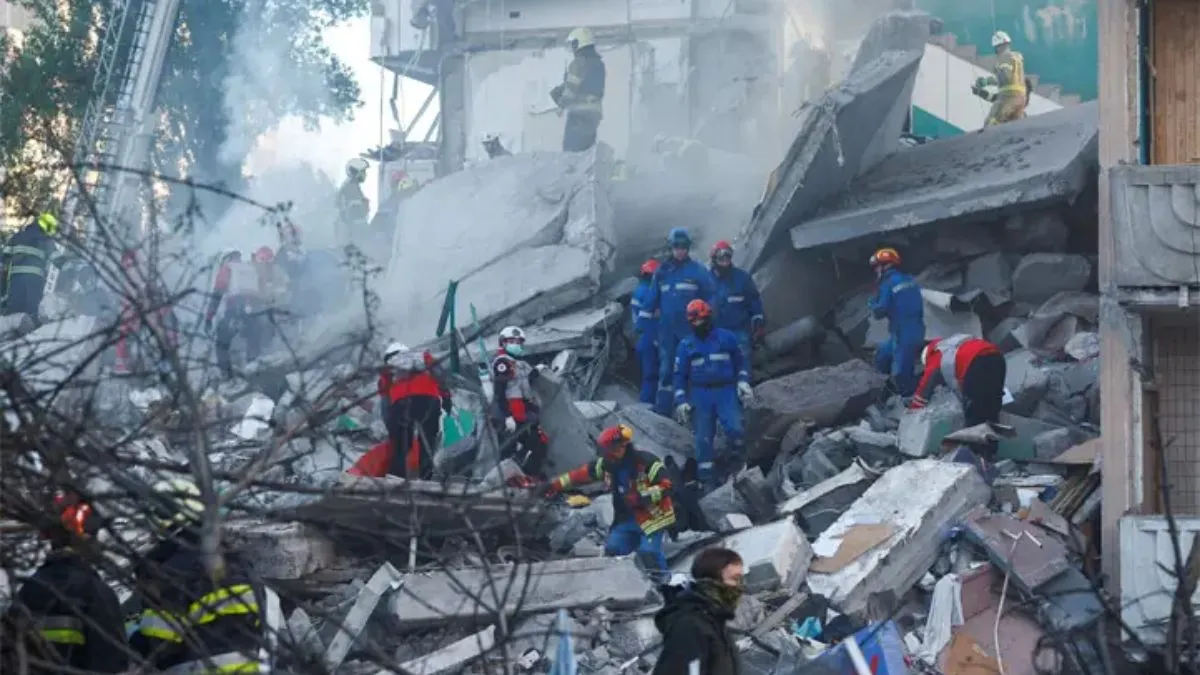
At approximately 3 a.m. on Thursday, Lyudmila Hlushko, 78, lay awake in her Kyiv apartment as waves of explosions shook the city. “Then the house shook violently and there was a loud bang, breaking the glass in my house,” she told reporters. A few streets away, in the Darnytskyi district, rescue workers were cutting through concrete to reach survivors trapped inside a nine-story residential building — an entire section of the structure reduced to rubble by a direct Russian drone strike. Two of the dead were young girls.
Also Read: US Intelligence: Putin Ukraine War Goals Remain Unchanged
What unfolded across Ukraine on May 13 and 14, 2026, was not a routine bombardment. It was a meticulously planned, two-day aerial campaign of unprecedented scale — the heaviest wartime attack in the Russia-Ukraine war’s four-year history since Russia launched its full-scale invasion in February 2022. By Thursday morning, Ukrainian President Volodymyr Zelensky confirmed Russia had deployed more than 1,560 drones since the start of Wednesday, alongside 56 ballistic and cruise missiles fired overnight. Ukrainian air defences intercepted 652 drones and 41 missiles — a remarkable operational achievement — but what broke through was enough to leave Kyiv counting its dead while the rest of the country scrambled for cover.
Russia-Ukraine War: Record Scale of the Attack
According to Ukraine’s Air Force, 675 attack drones and 56 missiles were launched in the overnight wave alone, with Kyiv as the primary target in the Russia-Ukraine war’s latest and most devastating escalation. Six districts of the capital sustained confirmed damage. In the Darnytskyi district, a multistory residential building partially collapsed; at least 27 people were rescued from the debris. Kyiv Mayor Vitali Klitschko reported 18 apartments completely destroyed and declared Friday a city day of mourning.
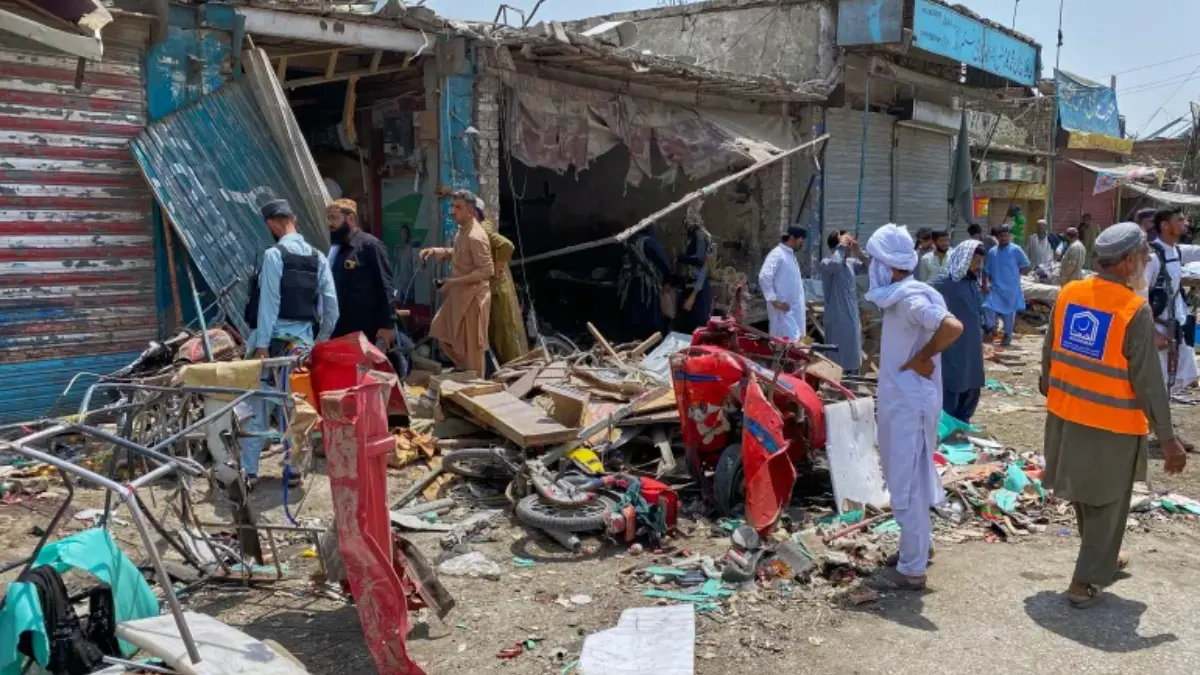
Zelensky confirmed that 20 sites in the capital were struck, including homes, a school, a veterinary clinic, and civilian infrastructure. Energy company DTEK reported a power substation and high-voltage power line knocked out, leaving parts of Kyiv without electricity. Ukrainian Deputy Prime Minister Oleksii Kuleba confirmed Russian strikes on ports in the southern Odesa region and railway infrastructure — a train locomotive was hit in the Kharkiv region, though its crew evacuated safely.
The Russian missile strike campaign extended far beyond the capital. The cities of Kremenchuk, Bila Tserkva, Kharkiv, Sumy, Odesa, Poltava, and Zaporizhzhia were all targeted. At least 28 people were injured in Kharkiv Thursday morning. In the Rivne region, three people were killed and six injured. In Ivano-Frankivsk, a drone struck a residential high-rise, injuring ten people including two teenagers and a two-month-old infant. Across all regions, Ukrainian emergency services reported more than a dozen people still missing as of Thursday afternoon.
“These are definitely not the actions of those who believe the war is coming to an end.”
Ukraine Air Defence Under Maximum Pressure
The sheer volume of this Russian drone attack on Ukraine was designed with one strategic goal: to overwhelm Ukraine’s air defence systems. By launching 675 drones and 56 missiles in a single overnight wave — following a daytime assault of 800+ UAVs on Wednesday — Russia forced Ukraine’s air defence units to fire continuously for roughly 11 hours straight, according to CNN’s team on the ground in Kyiv. Air raid sirens rang without pause across the city throughout the night.
Ukraine’s air force identified a new Russian tactic in this assault: deploying mass Shahed drone waves specifically along the Belarusian border to stretch Ukraine’s air defence network across multiple fronts simultaneously. The goal, as Zelensky put it, was to “overload” the air defence. The strategy came perilously close to succeeding — the 23 drones and 15 missiles that broke through caused structural collapses, fires across six city districts, and left parts of the capital without water or electricity.
According to researchers at the Combating Terrorism Center (CTC) at the United States Military Academy, Russia launched more than 8,000 drones in April 2026 alone — the highest monthly total on record since the full-scale invasion began. Monthly Shahed drone usage has more than tripled since 2024, rising from under 1,000 per month to nearly 3,500. The Russia-Ukraine war has, in the words of CTC analysts, demonstrated “an unprecedented level of drone deployment, with both sides using thousands of drones per month in increasingly complex and large-scale operations.”
Zelensky: Attack Timed to Sabotage Peace Talks
Ukrainian officials were swift to frame this Russian attack on Ukraine in explicitly geopolitical terms. The barrage began precisely as U.S. President Donald Trump arrived in Beijing for a three-day state visit — his first trip to China in nine years — accompanied by a high-profile delegation including Nvidia CEO Jensen Huang, Elon Musk, Apple’s Tim Cook, and BlackRock’s Larry Fink.
Zelensky was direct: “It is definitely impossible to call one of the longest massive Russian attacks against Ukraine an accident just at the time when the President of the United States arrived on a visit to China — a visit from which much is expected. Russia is clearly trying to spoil the general political background and attract attention at the expense of Ukrainian lives and Ukrainian infrastructure.”
Also Read: Trump Rejects Iran Ceasefire Proposal, Calls It ‘Totally Unacceptable
Ukrainian Foreign Minister Andrii Sybiha reinforced that message on X, writing that the attack showed Russia wants to continue fighting “despite a peace push by Washington,” and called on the U.S. and China to use their combined leverage to pressure Moscow. “There should be no illusions: only pressure on Moscow can force him to stop,” he wrote.
Zelensky also said Russian intelligence had deliberately stockpiled drones and missiles over several weeks before releasing them in a coordinated wave — specifically timed to maximise the scale of the Russian drone attack on Ukraine and minimise the effectiveness of Ukrainian air defence systems.
Peace Talks in Crisis as Russia Bombs and Negotiates
The Russia-Ukraine war’s diplomatic track has never looked more contradictory. Just days before this attack, a brief ceasefire had been observed as Putin presided over Russia’s Victory Day parade in Red Square — and the Kremlin had even permitted Putin to suggest the war may be “heading to an end.” Trump said Tuesday he believed the two sides would “soon reach a deal.”
Within 48 hours, those signals were rendered meaningless by the scale of the Russian military attack on Ukraine. The ceasefire was barely observed. And on Wednesday morning, Russia launched the largest single daytime drone assault the war had ever seen — 800 UAVs striking 20 regions, described by Zelensky as designed to cause maximum “pain and grief.” It was the opening act of the two-day record assault.
The Kremlin repeated its longstanding condition for any ceasefire in the Russia-Ukraine war: Ukraine must fully withdraw from the eastern Donbas region. Kyiv has categorically rejected that demand. Moscow offered no comment on the death toll or the scale of the strikes. The contradictions of the Russian position — engaging in U.S.-mediated talks while launching its most devastating aerial campaign — have led Western officials to openly question whether Moscow has any genuine interest in a negotiated peace.
Key Targets Hit
- Nine-story residential building — Darnytskyi district, Kyiv (2 girls killed, 27 rescued, 18 apartments destroyed)
- Power substation and high-voltage power line — Kyiv (DTEK confirmed)
- School and veterinary clinic — Kyiv (20 civilian sites struck in capital)
- Railway locomotive — Kharkiv region (crew evacuated safely)
- Odesa ports — confirmed by Deputy PM Kuleba
- Water supply disrupted — left bank of Kyiv (Mayor Klitschko)
- SBU building — Lutsk, Volyn region
- High-rise residential building — Ivano-Frankivsk (10 injured including 2 teenagers and infant)
- 49 settlements struck in Zaporizhzhia region in single day (973 Russian strikes)
Survivors Speak: Life Under the Rubble
At the collapsed building in Kyiv’s Darnytskyi district, Olena Suntovska, 38, described the moment of impact. “I heard a loud explosion. I ran out to the kitchen and saw people running around the yard, calling for help. Then I rushed out of the building and saw that the front entrance was gone,” she told CNN. “I was scared — it’s so stressful for me because I was worried about the kids,” the mother of three said. Another resident, Alla Komisarova, 74, stood near the wreckage holding back tears. “There were people there, children. What happened to them? An entire building collapsed,” she told Reuters.
Another man in Kyiv died in hospital from injuries sustained in a separate Russian strike on a gas station. By Thursday afternoon, emergency services confirmed that more than a dozen people remained missing as crews continued clearing rubble. At least 27 had been rescued alive.
Why This Russia-Ukraine War Escalation Matters Globally
For the world watching the Russia-Ukraine war, this week’s events carry implications that extend far beyond the front lines. They confirm that Russia retains both the industrial capacity and strategic willingness to dramatically escalate — even while nominally engaging in U.S.-mediated peace talks. That duality — negotiate and bomb simultaneously — has become Moscow’s defining posture in the Russia-Ukraine war’s current phase.
For the Trump administration, the Russian military attack on Ukraine is an uncomfortable complication to its stated goal of brokering a rapid settlement. The U.S.-mediated 20-point peace framework, outlined during a December 2025 Trump-Zelensky meeting in Palm Beach, has stalled on the issues that have always divided the two sides: territorial concessions, security guarantees for Ukraine, and control of the Zaporizhzhia Nuclear Power Plant — currently under Russian occupation.
Zelensky has been consistent in his position throughout the Russia-Ukraine war: Ukraine will not sign any deal that legitimises Russia’s land seizures or leaves the country without binding protection against future invasion. Recent surveys by the Kyiv International Institute of Sociology show 69% of Ukrainians would accept a peace plan that freezes the current front line — but only if it includes legally binding security guarantees from Western nations. That condition remains unmet.
Russia currently occupies approximately 20% of Ukrainian territory — roughly 45,737 square miles, an area comparable to the U.S. state of Pennsylvania — since the start of the full-scale invasion, according to data from the Institute for the Study of War (ISW). Despite over 1.34 million estimated Russian combat losses since February 2022, Moscow shows no signs of altering its strategic objectives in the Russia-Ukraine war.
“Russian representatives engage in lengthy talks, but in reality, Kinzhals and Shaheds speak for them.”
Conclusion: The Russia-Ukraine War at a Defining Crossroads
The Russia-Ukraine war has entered what analysts describe as its most strategically complex phase since the opening months of the invasion. Russia’s drone war is getting bigger. Its missile strike capability remains lethal. And its willingness to escalate during diplomatic windows suggests that Moscow’s endgame — whatever it truly is — has not fundamentally changed.
For Kyiv, the challenge is as stark as it has ever been: fight, negotiate, and survive simultaneously — with insufficient air defences, an energy grid operating at one-third of pre-war capacity, and a diplomatic process that keeps producing frameworks but not ceasefires. For Ukraine’s Western partners, the question the Russia-Ukraine war now demands an answer to is simple: how much pressure on Moscow is actually being applied, and is it enough?
For Alla Komisarova, 74, standing in the grey dawn light outside the rubble of her neighbour’s building, those questions belong to governments and summits. What mattered on Thursday morning, in the Russia-Ukraine war’s 1,175th day, was the concrete being moved by hand, block by block, searching for those still missing — children among them.