









FIFA World Cup 2026 Extreme Weather Fears: Scientists Sound Red Alert as Tournament Approaches
It is the most-watched sporting event on the planet. And this summer, it is heading into some of the hottest, most climate-stressed conditions ever faced by a global tournament on North American soil.
Less than a month before the opening whistle at the 2026 FIFA World Cup, a landmark scientific report has delivered a blunt warning: nearly one in four matches could be played under conditions dangerous enough to threaten player safety and fan health alike. The data, published Thursday by the World Weather Attribution (WWA) — an international scientific network that includes researchers from Imperial College London, the Royal Netherlands Meteorological Institute, and the Red Cross Red Crescent Climate Centre — leaves little room for reassurance.
Also Read: When Will FIFA World Cup 2026 Start? Full Guide for Fans
This is not speculation or distant modelling. The FIFA World Cup 2026 extreme weather fears are grounded in historical weather records, real-time climate data, and the lived experience of athletes who competed in the same venues just last summer. The extreme heat risk to players and spectators is real, documented, and growing. The tournament, running from June 11 to July 19 across 16 cities in the United States, Mexico, and Canada, will unfold during the peak of the North American summer — and the North American summer has changed dramatically in the three decades since the US last hosted the World Cup in 1994.
FIFA World Cup 2026 Extreme Weather Fears: What the Science Actually Says
The WWA report centres on Wet Bulb Globe Temperature (WBGT) — the gold standard metric for measuring how heat actually affects the human body during physical exertion. Unlike a simple air temperature reading, WBGT simultaneously accounts for humidity, solar radiation, and wind speed, giving a far more accurate picture of how well the body can cool itself in real conditions.
The findings are stark. Approximately 26 of the tournament’s 104 scheduled matches are projected to be played when WBGT reaches at least 26°C — the level at which the International Federation of Professional Footballers’ Associations (FIFPRO) recommends that heat stress safety measures be urgently activated for player safety. That is roughly one in four games.
More troubling still: five matches could be played at or above 28°C WBGT. That is the threshold at which FIFPRO advises that matches should be delayed or postponed outright. In 1994, scientists estimate approximately three matches would have met that threshold. The number has nearly doubled in 32 years — a direct consequence, researchers say, of human-induced climate change.
“Our findings show conditions associated with these physiological heat-stress conditions have now become more likely and more intense than during the previous World Cup,” said Dr. Joyce Kimutai, a research associate in extreme weather and climate change at Imperial College London, during a press briefing on Wednesday. “These changes are confidently attributable to anthropogenic climate change.”
For context, host city temperatures today average 0.7°C warmer than they were during the 1994 tournament — a seemingly small number that, across an entire summer across 16 cities, translates into a measurable and dangerous shift in conditions.
The Warning Was Written Last Summer
Before the science was published, the football itself delivered the warning.
The FIFA Club World Cup, held across American venues in the summer of 2025 as a dress rehearsal for this year’s tournament, was disrupted repeatedly by extreme heat risk conditions. Player safety concerns dominated headlines. Chelsea midfielder Enzo Fernández — one of the most physically conditioned athletes in world football — described conditions during a semi-final at MetLife Stadium in New Jersey, played in 96°F (approximately 36°C) heat, as “very dangerous.”
“Honestly, the heat is incredible,” Fernández said after the match. “The other day I got a little dizzy during a play. I had to lie down on the ground because I was really dizzy. Playing in this temperature is very dangerous.”
That semi-final kicked off at 3:00 PM local time. So does the World Cup Final.
FIFA President Gianni Infantino acknowledged the problem publicly following the Club World Cup’s heat controversy: “Every criticism we receive is a source for us to study and analyse what we can do better. Cooling breaks are very important and we will see what we can do, but we have stadiums with roofs and we will definitely use these stadiums during the day next year.”
City by City: Where the Risks Are Most Severe
The danger is not evenly distributed. Understanding the geography of risk is essential to understanding the full scale of the challenge.
Miami: Near-Certain Heat Danger
Miami is the most exposed venue in the entire tournament. Six open-air matches scheduled there face what scientists describe as a “near certainty” of exceeding 26°C WBGT. For two of those matches — on July 11 and July 18 — there is a one-in-33 chance of conditions tipping past the 28°C postponement threshold. Miami’s combination of subtropical heat, persistent humidity, and intense afternoon sun makes it physiologically unforgiving for sustained athletic performance at the highest level.
MetLife Stadium: The Final’s Open-Air Gamble
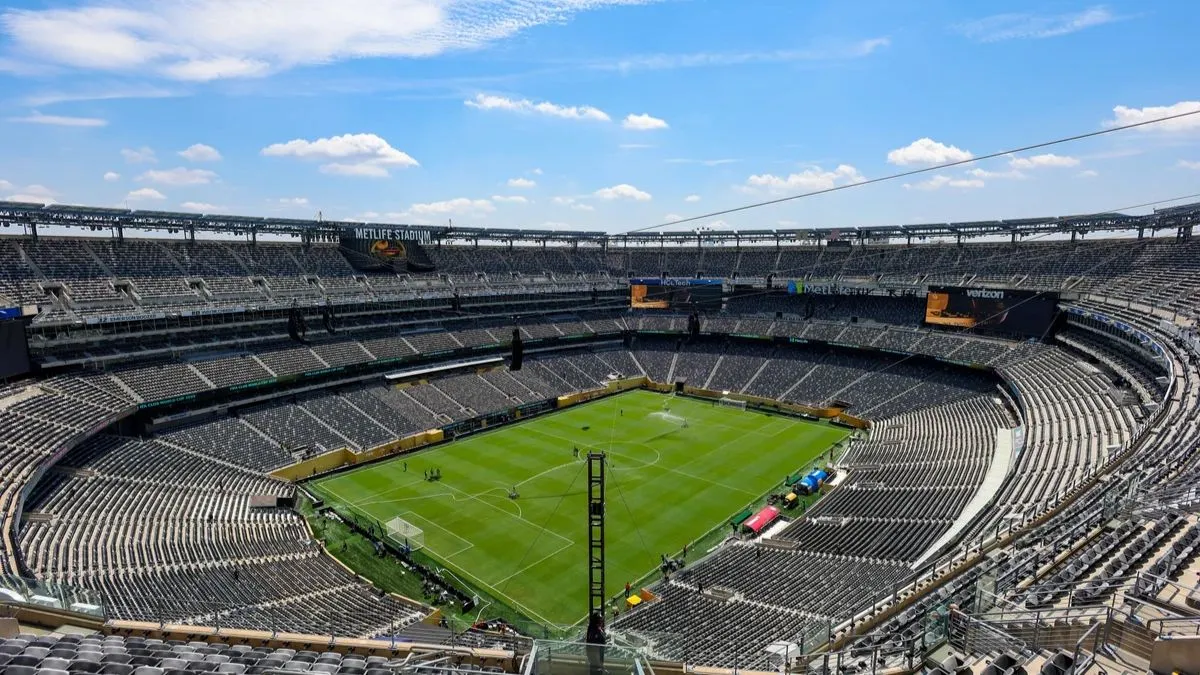
The World Cup Final on July 19 will be played at MetLife Stadium in East Rutherford, New Jersey — an open-air venue with no roof and no air conditioning. According to WWA analysis, the stadium now carries a one-in-eight chance of reaching 26°C WBGT conditions on final day, and its overall risk of heat-related disruption has increased by up to 50 per cent since the 1994 tournament.
“There’s a very real risk that we’ll be faced with games taking place in conditions that are unsafe for players and fans,” said Dr. Kimutai.
The WWA report also found a “non-insignificant risk” of the Final being played in what scientists classify as “cancellation-level heat” — an extraordinary phrase to attach to football’s biggest match.
Dallas and Houston: Hot but Protected
Both Texas cities face WBGT readings that could exceed 32°C (90°F) on summer afternoons. However, both stadiums are enclosed and air-conditioned, which provides meaningful protection for players and spectators inside. “We don’t anticipate any weather-related issues inside,” said Tim Ciesco of the Arlington Police Department, which oversees the Dallas venue.
Kansas City: Evening Kickoffs Are No Guarantee
Even matches scheduled for evening kickoffs are not automatically safe. WWA researchers found that a Netherlands vs. Tunisia fixture in Kansas City, starting at 6:00 PM local time, carries a 7% chance of exceeding the 28°C WBGT postponement threshold. The finding underscores that scheduling alone cannot eliminate the risk — the heat lingers long after the sun begins to drop in these inland cities.
Monterrey, Mexico: Altitude Does Not Help
At lower altitudes in Mexico, Guadalajara and Monterrey can reach 32–35°C during summer afternoons, combining with humidity to create conditions that have historically challenged even well-conditioned athletes. The Central Region of the tournament host map, characterised by subtropical climates, represents the highest-risk cluster overall.
The Gap Between Guidelines and FIFA Rules
One of the most pointed tensions highlighted by the FIFA World Cup 2026 extreme weather fears debate is the disconnect between what medical science recommends and what FIFA’s own regulations currently require before action is taken. It is a gap that sits at the heart of the climate change and football safety conversation.
FIFPRO advises activating heat measures at 26°C WBGT and postponing matches at 28°C. FIFA’s official rules, however, only mandate postponement consideration at 32°C WBGT — a full four degrees higher than the players’ union threshold.
Also Read: 2026 FIFA World Cup Groups Announced in Spectacular Draw
“Above 28°C, the risk of serious heat illness becomes more concerning — not only for players, but also for the hundreds of thousands of fans in stadiums and outdoor fan festivals,” said Dr. Mullington, a heat illness specialist whose research informed the WWA findings. “Heat stroke, the most severe form of heat illness, is life-threatening, and older people and those with pre-existing medical conditions are particularly vulnerable.”
This is not a gap between overly cautious scientists and a careless governing body. It is a gap between what player welfare research shows and what tournament logistics currently accommodate. Closing it will require decisions that go beyond adding a cooling break.
What FIFA and Host Cities Are Actually Doing
To its credit, FIFA has taken concrete steps on player safety — even if critics argue they do not go far enough given the scale of World Cup 2026 heat danger facing the tournament.
All 104 World Cup matches will now feature mandatory three-minute hydration breaks at the 22-minute mark of each half, regardless of weather conditions on the day. This directly addresses heat stress concerns and replaces the previous protocol, which only triggered cooling breaks when temperatures exceeded 31°C at kickoff. Teams will benefit from a minimum of three rest days between matches, climate-controlled benches at outdoor venues, and the option of up to five substitutions per game.
“Outdoor matches during the hottest parts of the day have been strategically limited, kick-off times adjusted in certain markets, and matches expected in warmer windows prioritised for covered stadiums where possible,” FIFA said in an official statement.
At the city level, preparations vary but are broadly serious. In Dallas, all outdoor medical professionals will have access to ice and ice immersion bags, and the city’s fan festival site will feature two climate-controlled medical stations. Seattle’s Office of Emergency Management is exploring air-conditioned buses, tents, and water misters at fan zones. Vancouver, which will host seven matches at the fully covered BC Place stadium — one of only four fully enclosed World Cup venues — is providing shaded seating across all tournament locations. Santa Clara, California, has scheduled all its matches in the evening to take advantage of cooler coastal conditions.
Host cities are also deploying multilingual heat-awareness campaigns and stationing medical teams at FIFA Fan Festivals and outdoor viewing events where fans will gather in large numbers in direct sun.
Fans Are Not Just Spectators in This Risk
The focus on players is understandable — they are the ones performing at maximum physical intensity. But scientists are increasingly insisting that spectators deserve equal attention in heat planning.
Fans attending World Cup matches will spend hours exposed to direct sunlight before and after kickoff, navigating public transport, standing in queues, and moving through outdoor fan zones. Many will be travelling internationally, unacclimatised to the local heat. Many will be older adults, families with young children, or individuals with pre-existing cardiovascular or metabolic conditions.
“Spectators are more medically diverse, may be older or very young, may have cardiovascular disease, kidney or metabolic disease,” one heat medicine expert noted at the WWA press briefing. He called on all 16 host cities to ensure robust on-site access to water, shaded rest zones, sufficient medical staffing, and transport planning that accounts for the physiological burden of heat on large crowds.
William Adams, assistant professor in kinesiology at Michigan State University who researches exertional heat stress, noted that while educational campaigns about hydration and shade are helpful, research consistently shows they are not enough on their own. “It requires a more active approach,” he said, “but that isn’t really feasible with large events like this one.” It is an honest admission of a genuine gap.
A Larger Story: Sport Confronting a Changed World
There is a moment in the WWA report that captures something larger than football. “The 1994 World Cup may not feel particularly distant to many adults today,” wrote Dr. Friederike Otto, professor of climate science at Imperial College London and co-founder of WWA, “yet half of human-induced climate change has happened since then.”
Half. Since 1994.
The FIFA World Cup 2026 extreme weather fears are, at root, a story about what happens when the world’s most ambitious sporting calendar runs up against decades of accumulated warming. The broader climate change and football safety crisis is no longer a future concern — it is arriving in real time, this summer, across sixteen cities. The 2022 Qatar World Cup was moved entirely from summer to winter to avoid extreme heat risk. North America in 2026 does not have that option.
What the WWA report ultimately asks is not whether the tournament should go ahead — it will — but whether the institutions that govern sport are moving quickly enough to protect the people inside it. Players, fans, volunteers, and officials are not abstract stakeholders in a climate report. They are real people who will be in stadiums and fan zones across sixteen cities over six weeks of peak summer heat.
The scientists have done their job. The data is clear. Whether football’s governing bodies respond with the urgency the moment demands is a question that will be answered, match by match, across the next two months.
The 2026 FIFA World Cup runs from June 11 to July 19 across 16 host cities in the United States, Mexico, and Canada. The World Cup Final takes place on July 19 at MetLife Stadium, East Rutherford, New Jersey.