






Thailand Launches Airstrikes on Cambodia as Trump’s Peace Deal Faces Collapse
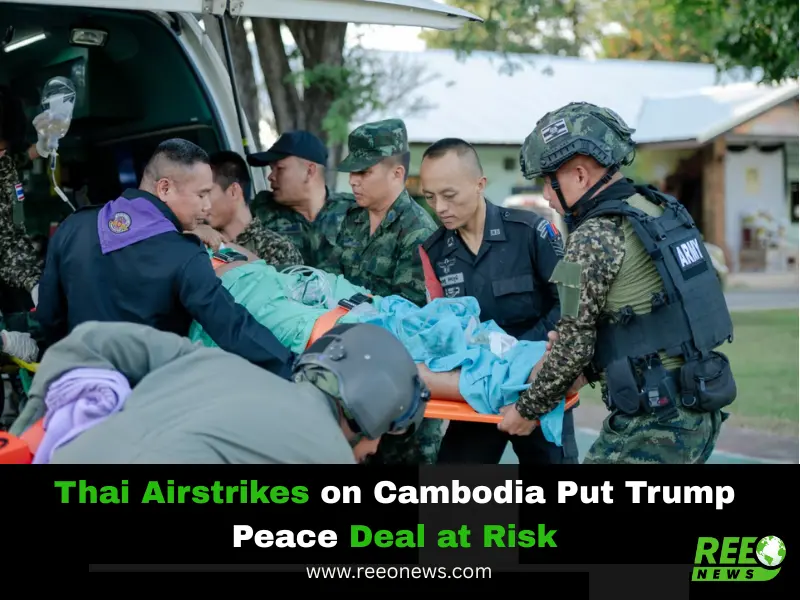
Thailand launched airstrikes against Cambodia early Monday as fresh fighting erupted along the disputed border, placing a Trump-brokered peace agreement signed just two months ago at serious risk of collapse.
Both countries traded accusations of initiating the hostilities, with Thailand asserting that its strikes were a direct response to a Cambodian attack that killed one Thai soldier and injured seven others. Cambodia, however, rejected the claims as “false information,” insisting it was Thailand that fired first after days of growing provocation.
The renewed clashes mark the most dangerous escalation since July, when the neighbours fought a deadly five-day conflict that killed dozens and displaced roughly 200,000 civilians.
Also Read: Saudi Arabia Eases Alcohol Rules for Foreign Residents
Thailand Calls Strikes ‘Retaliation’
In a statement on Monday, the Thai army said its airstrikes targeted Cambodian military infrastructure at the Chong An Ma Pass. Army spokesperson Maj. Gen. Winthai Suvaree accused Cambodian forces of using artillery and mortar launchers to attack the Thai Anupong Base earlier in the morning.
“The target was at Cambodia’s arms supporting positions,” Suvaree said, adding that Cambodia had mobilised heavy weapons near the frontier as early as 3 a.m. local time. The Royal Thai Air Force described the movements as “activities that could escalate military operations and pose a threat to the Thai border area.”
Prime Minister Anutin Charnvirakul said Thailand “never wished to see violence,” but warned the country would not tolerate any violation of its sovereignty. Future military action, he added, would depend on Cambodia’s behaviour.
Cambodia Rejects Thai Claims | Thai Airstrikes on Cambodia
Cambodia’s Ministry of National Defense firmly denied initiating any attack, calling the Thai allegations baseless. Instead, Cambodian officials accused Thailand of launching an assault at 5:04 a.m. local time.
“This attack occurred after the Thai forces engaged in numerous provocative actions for many days,” the Cambodian army said in a statement. The ministry added that Cambodia “did not retaliate at all” and was monitoring the situation “with utmost caution.”
Civilians Evacuated as Tension Builds
Thailand began evacuating residents from vulnerable border areas on Sunday, with military officials saying that around 70% of civilians had already been moved to safer zones. Local authorities warned that fighting could intensify if both sides fail to re-establish communication.
Trump’s Ceasefire Agreement at Risk
Monday’s fighting has cast a shadow over a peace process widely touted by former US President Donald Trump as a significant diplomatic win. After brokering separate conversations with Cambodian and Thai leaders, Trump helped secure an initial ceasefire on July 28, following the July border conflict.
In late October, Thailand and Cambodia signed an expanded ceasefire declaration during a ceremony in Kuala Lumpur witnessed by Trump and Malaysian Prime Minister Anwar Ibrahim. But the agreement began showing cracks within two weeks, after a landmine explosion injured several Thai soldiers and prompted Bangkok to suspend progress on the deal.
With Monday’s airstrikes, analysts fear the agreement may now unravel completely.
Also Read: Chukwueze Banks on Home Strength as Fulham Face Palace
Regional Leaders Urge Restraint
Malaysian Prime Minister Anwar Ibrahim expressed deep concern over the renewed clashes, warning that the progress made in stabilising Thai–Cambodian relations could be undone.
“The renewed fighting risks unravelling the careful work that has gone into stabilising relations between the two neighbours,” he said.
Malaysia, Thailand and Cambodia are all members of ASEAN, a regional bloc that prioritises political cooperation and regional stability. Diplomatic tensions between member states pose a direct challenge to the group’s goals.
A Border Shaped by History
The frontier between Thailand and Cambodia spans more than 800 kilometres, with disputes rooted in maps drawn during French colonial rule over Cambodia. Thailand has long rejected key sections of the colonial-era demarcation, leading to repeated clashes, most notably near the Preah Vihear Temple and other contested areas.
With both sides blaming each other for Monday’s violence, the region faces the risk of a widening conflict unless diplomatic efforts resume quickly.
As airstrikes and artillery fire once again echo across the Thai–Cambodian border, the Trump-brokered ceasefire appears increasingly fragile. Both countries remain on high alert, civilians are fleeing their homes, and ASEAN leaders are calling urgently for restraint. Without renewed dialogue, Southeast Asia could witness one of its most serious interstate confrontations in years.