







International Gaza Force Deployment
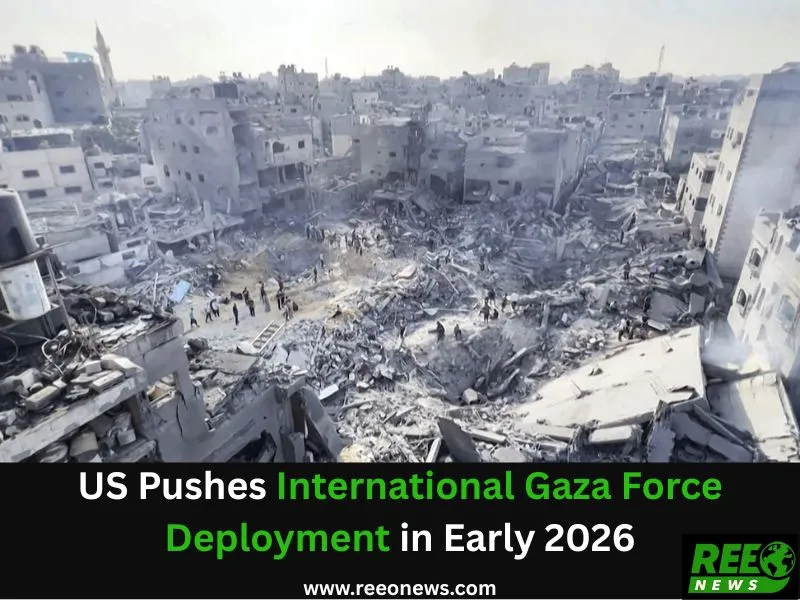
The United States is intensifying diplomatic and military coordination efforts to deploy an international Gaza force deployment as early as next year, signaling a significant new phase in post-war stabilization efforts in the war-torn enclave. According to U.S. officials cited by Reuters, the proposed International Stabilization Force (ISF) would operate under United Nations authorization, aiming to support security, reconstruction, and a gradual transition toward long-term peace in the Gaza Strip.
Also Read: Saudi Arabia’s Photography Ban for Hajj 2026 Explained
The plan comes as part of the second phase of the Gaza peace initiative promoted by U.S. President Donald Trump, following a fragile ceasefire that began in October after two years of devastating conflict. While the ceasefire has enabled limited humanitarian relief and prisoner exchanges, deep political and security challenges remain unresolved—particularly the issue of demilitarization.
What Is the International Stabilization Force (ISF)?
The International Stabilization Force is envisioned as a multinational, UN-authorized mission designed to help stabilize Gaza after prolonged conflict. U.S. officials emphasize that the ISF is not intended to fight Hamas directly, but rather to provide security support, oversee stabilization measures, and create conditions that allow for reconstruction and governance reforms.
Key planning areas currently under discussion include:
-
Size and composition of the force
-
Rules of engagement
-
Housing and logistics
-
Training coordination with local Palestinian security forces
An American two-star general is reportedly being considered to lead the ISF, though no final decision has been announced. Several countries have already expressed interest in contributing personnel, reflecting growing international concern over Gaza’s long-term stability.
UN Authorization and the Board of Peace
A critical element of the international Gaza force deployment is its legal mandate. On November 17, the United Nations Security Council adopted a resolution authorizing the creation of the ISF and establishing a governing mechanism known as the Board of Peace.
The Board of Peace will oversee:
-
Strategic direction of the ISF
-
Coordination among contributing nations
-
Benchmarks for security and demilitarization
President Trump has stated that the names of world leaders serving on the Board of Peace will be announced in early 2026, underscoring Washington’s intent to maintain strong international backing for the mission.
Indonesia Signals Major Troop Contribution
Among the countries showing readiness to participate, Indonesia has drawn particular attention. Indonesian officials have said they are prepared to deploy up to 20,000 troops, primarily focused on non-combat roles such as healthcare delivery, engineering, and infrastructure reconstruction.
Also Read: Opera Legend Jubilant Sykes Stabbed to Death at Home
Indonesia’s defense ministry noted that the plan is still in the organizational and preparation stage, but the scale of the potential contribution highlights how the international Gaza force deployment could extend beyond security into humanitarian and rebuilding efforts.
Territorial Control and Israeli Withdrawal Plans
At present, Israel controls approximately 53% of Gaza, while nearly two million Palestinians reside in the remaining areas largely held by Hamas. Under the proposed plan, the ISF would initially deploy in areas currently under Israeli control.
As stability improves, Israeli forces would gradually withdraw, with timelines tied to measurable security standards and progress toward demilitarization. This phased withdrawal is considered one of the most sensitive aspects of the plan, given Israel’s security concerns and Hamas’s continued influence.
Demilitarization: The Central Challenge
Demilitarization remains the most contentious issue surrounding the international Gaza force deployment. The UN Security Council mandate authorizes the ISF to support efforts to dismantle militant infrastructure, prevent the rebuilding of weapons facilities, and ensure the permanent decommissioning of arms held by non-state groups.
The ISF is also expected to work alongside newly trained and vetted Palestinian police forces, integrating local security structures into a broader stabilization framework. However, exactly how demilitarization will be enforced on the ground remains unclear.
U.S. Ambassador to the UN Mike Waltz has noted that the Security Council authorization allows the ISF to use force if necessary, though rules of engagement are still being negotiated with participating countries.
Hamas Rejects Disarmament Without Statehood
Hamas has publicly stated that formal discussions on disarmament have not taken place with mediators, which include the United States, Egypt, and Qatar. The group maintains that it will not lay down its weapons until a fully recognized Palestinian state is established.
This stance poses a significant obstacle to the success of the international Gaza force deployment, as demilitarization is a core requirement of the UN mandate and Israel’s security demands.
Israel’s Cautious Support
Israeli Prime Minister Benjamin Netanyahu has expressed conditional support for a multinational task force, welcoming international assistance while questioning whether such a force could fully neutralize militant threats.
Also Read: Japan Powerful Quake Triggers Megaquake Warning Alert
Netanyahu has suggested that while the ISF may handle certain stabilization and security tasks, Israel may still need to retain responsibility for operations beyond the force’s capabilities. His remarks reflect ongoing skepticism within Israel about relying solely on international mechanisms for long-term security.
Why the International Gaza Force Matters
If implemented, the international Gaza force deployment would represent one of the most significant international interventions in Gaza’s history. Supporters argue it could:
-
Reduce the risk of renewed large-scale conflict
-
Enable sustained humanitarian access
-
Support reconstruction and governance reforms
-
Create conditions for renewed political negotiations
Critics, however, warn that without a clear political settlement and agreement on disarmament, the ISF could face serious operational and legitimacy challenges.
Conclusion
The planned international Gaza force deployment marks a pivotal moment in efforts to move beyond ceasefire toward lasting stability in Gaza. Backed by the United States and authorized by the United Nations, the initiative reflects growing international willingness to shoulder responsibility for Gaza’s future.
Yet major uncertainties remain—from Hamas’s refusal to disarm, to Israel’s security concerns, to the complexities of coordinating a multinational force in one of the world’s most volatile regions. Whether the ISF can bridge these gaps will determine not only the success of the mission, but also the prospects for enduring peace in Gaza.