








3I/ATLAS Interstellar Comet Scanned for Technosignatures, None Detected by Telescope
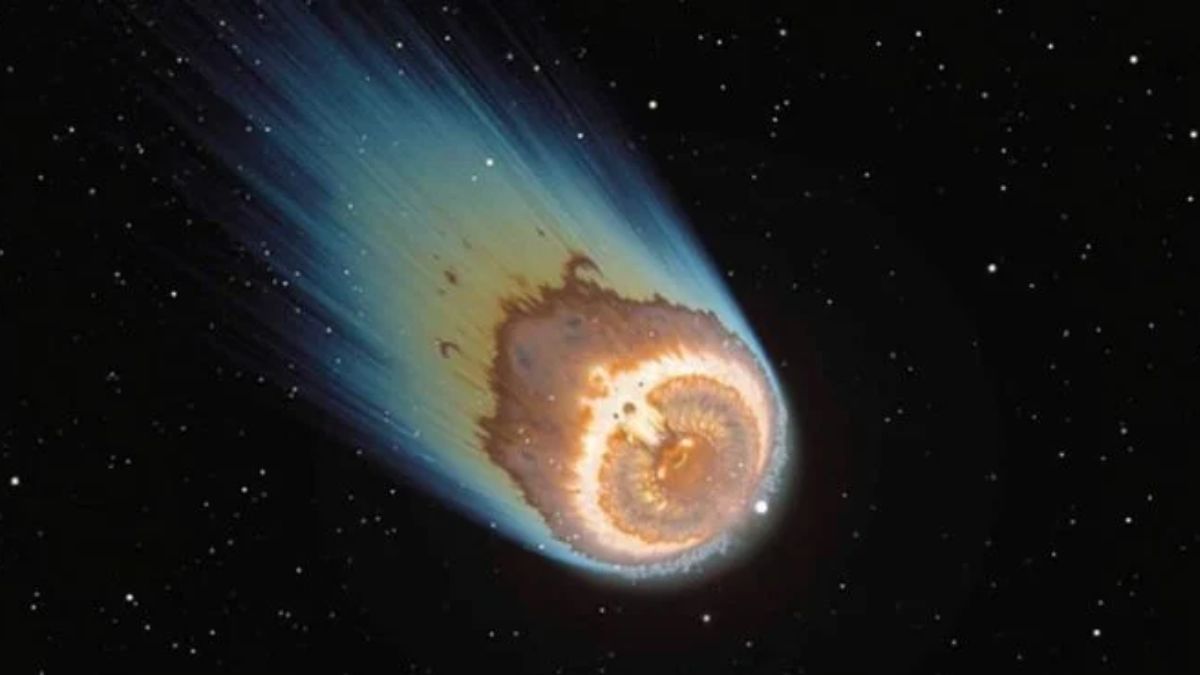
The interstellar comet 3I/ATLAS passed through our solar system in late 2025. It was first detected in July 2025 by the NASA-funded ATLAS survey in Chile. The comet came within approximately 270 million kilometers (167 million miles) of Earth.
Researchers from the Breakthrough Listen initiative scanned 3I/ATLAS for signs of alien technology, known as technosignatures. Using the Green Bank Telescope, the team observed the comet for five hours. No artificial radio signals were detected.
Also Read: Pakistan National AI Conference Planned for Early 2026
The comet is especially intriguing due to its unusual physical characteristics. Harvard astrophysicist Avi Loeb highlighted several anomalies in Hubble images, including a long sunward “anti-tail” and a three-pronged inner jet pattern. These features initially sparked speculation that 3I/ATLAS could be artificial rather than a natural comet. Loeb even proposed a “Loeb scale” to rate the likelihood of an interstellar object being of alien origin, ranging from zero for a natural icy rock to ten for confirmed extraterrestrial technology. When 3I/ATLAS was first observed, Loeb ranked it a four on his scale.
Researchers Confirm 3I/ATLAS Behaves as Natural Comet
Despite this intrigue, the Breakthrough Listen observations reaffirm the comet’s natural status. Using an “on-off” switching method to filter interference from Earth-based satellites and aircraft, the research team detected no alien signals or artificial radio emissions. According to the Search for Extraterrestrial Intelligence (SETI) Institute, 3I/ATLAS continues to exhibit behaviors consistent with natural astrophysical processes, including a coma surrounding its nucleus and unelongated core characteristics typical of comets.
This episode echoes the public fascination seen with prior interstellar visitors, such as ʻOumuamua in 2017 and 2I/Borisov in 2019. In both cases, initial speculation about alien origins drew widespread attention, only to be tempered by further scientific analysis confirming natural explanations. NASA officials have reinforced this point regarding 3I/ATLAS. “This object is a comet,” stated NASA associate administrator Amit Kshatriya during a November 2025 briefing, citing its trajectory, composition, and observed behavior.
While the Green Bank Telescope results provide a robust snapshot, researchers caution that these observations are not exhaustive. Stronger signals can sometimes obscure weaker emissions, and slight variations in image processing may alter perceptions of cometary jets. Nonetheless, the consensus is clear: 3I/ATLAS is behaving as a natural interstellar comet, not an alien probe.
Also Read: TikTok Reaches Agreement to Sell Stake in U.S. Operations
Loeb continues to meticulously document the comet’s unusual properties, including its suspected size and finely tuned trajectory, which brings it within tens of millions of miles of Mars, Venus, and Jupiter. However, given the substantial evidence that the object is largely composed of carbon dioxide and water ice, the likelihood of it being an extraterrestrial probe is steadily declining. Scientists also note that if the comet were a deliberate alien probe, it would make sense to communicate with Earth during its closest approach, as our planet emits abundant radio transmissions that could serve as beacons.
The Breakthrough Listen initiative emphasizes the scientific value of 3I/ATLAS despite the null detection. Interstellar objects are extremely rare, with only three confirmed visitors to date, making each one a precious opportunity to study material from beyond our solar system. Detailed observations of such objects enhance understanding of cometary physics, interstellar chemistry, and the dynamics of objects traveling between star systems.
In conclusion, the interstellar comet 3I/ATLAS remains a silent traveler through our solar system. While speculation about alien signals has captured public imagination, current evidence strongly supports its classification as a natural comet. The search for technosignatures continues to be an important part of astrophysical research, but for now, 3I/ATLAS offers astronomers a rare glimpse into the materials and trajectories of interstellar visitors. Scientists worldwide will continue to observe and analyze the object as it moves away from Earth, ensuring that even quiet cosmic visitors can provide valuable insights into the universe beyond.