








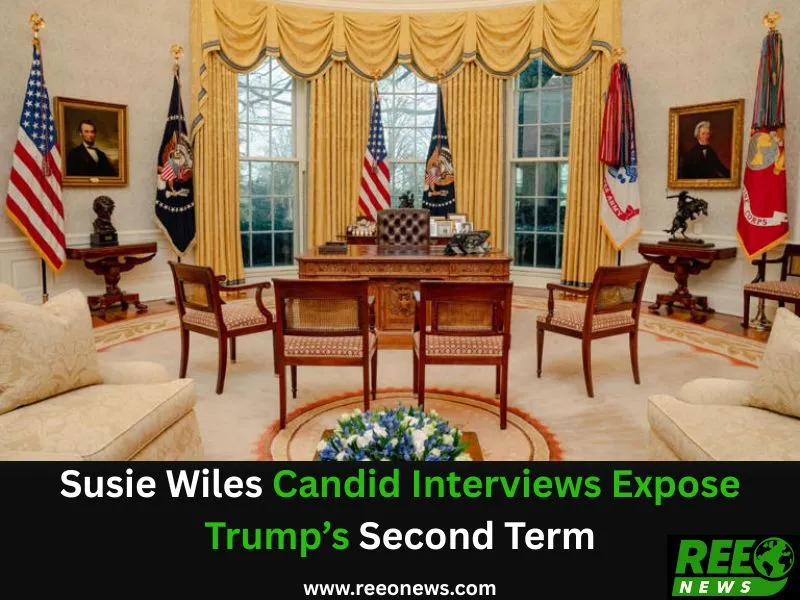
Susie Wiles candid interviews
The Susie Wiles candid interviews published by Vanity Fair have sent shockwaves through Washington, offering one of the most unfiltered looks yet into President Donald Trump’s second-term White House. Rarely does a sitting chief of staff speak so openly—and critically—about a president, his allies, and the internal conflicts shaping an administration. That reality has turned these interviews into a defining political moment, raising urgent questions about power, loyalty, and governance at the highest level.
Also Read: Bondi Beach Terror Attack Kills 11 at Jewish Event
Wiles, long regarded as a disciplined and strategic political operator, is not known for freelancing or loose talk. Her decision to engage in more than a dozen wide-ranging conversations with political author Chris Whipple has therefore stunned both allies and critics of the president alike.
A Powerful Yet Private Figure Steps Into the Spotlight
As White House chief of staff, Susie Wiles has been described by Trump himself as “the most powerful woman in the world.” Unlike her predecessors from Trump’s first term, she has maintained order in the West Wing while preserving the president’s trust. Her low public profile made the Susie Wiles candid interviews all the more surprising.
According to the interviews, Wiles sees Trump as a leader with an unshakable belief in his own authority. “There’s nothing he can’t do,” she said, describing a president who governs with near-total confidence in his personal power.
‘An Alcoholic’s Personality’ Without Alcohol
The most headline-grabbing remark from the Susie Wiles candid interviews was her assertion that Trump “has an alcoholic’s personality,” despite being a teetotaler. Wiles clarified that she was referring to exaggerated traits such as impulsiveness and intensity—characteristics she understands well due to her upbringing as the daughter of legendary sportscaster Pat Summerall, who struggled with alcoholism.
Her comment was not meant as a medical diagnosis but as a psychological observation of how Trump’s personality shapes decision-making at the highest level of government.
Retribution as a Governing Motive
Perhaps more politically consequential were Wiles’ admissions about revenge and “score settling.” In the Susie Wiles candid interviews, she acknowledged that some second-term actions—including legal pressure on political opponents—could reasonably appear vindictive.
Also Read: US Pushes International Gaza Force Deployment in Early 2026
Discussing the failed prosecution of former FBI Director James Comey, Wiles conceded, “People could think it does look vindictive. I can’t tell you why you shouldn’t think that.” She added that while Trump may not wake up plotting revenge, “when there’s an opportunity, he will go for it.”
Policy Disputes Behind Closed Doors
The interviews also reveal a chief of staff frequently overruled. On deportations, Wiles warned that the administration needed to “look harder” to avoid mistakes. On January 6, 2021, she urged Trump not to pardon the most violent rioters—a recommendation he ignored.
Wiles also described fierce internal disagreement over tariffs, noting she unsuccessfully pushed Trump to delay major announcements amid economic uncertainty. These revelations portray a White House where advice is offered—but not always heeded.
Venezuela and the Limits of Presidential Power
Foreign policy emerged as another area of concern in the Susie Wiles candid interviews. Wiles suggested Trump is pursuing regime change in Venezuela, claiming he wants to continue military actions until President Nicolás Maduro “cries uncle.”
She acknowledged, however, that such strikes would require congressional authorization—underscoring the legal and constitutional tensions surrounding Trump’s approach to foreign intervention.
Epstein Files and Acknowledged Falsehoods
In a striking admission, Wiles stated there was no evidence that former President Bill Clinton visited the private island of convicted sex offender Jeffrey Epstein. “The president was wrong about that,” she said, directly contradicting Trump’s public claims.
She also criticized Attorney General Pam Bondi for mishandling the release of Epstein-related materials, saying Bondi “completely whiffed” by overpromising documents that did not exist.
Unvarnished Views of Trump’s Inner Circle
The Susie Wiles candid interviews offered blunt assessments of several key figures:
Also Read: PIA Denies Fake Reports of Entire Crew Missing in Toronto
Vice President JD Vance was described as “a conspiracy theorist for a decade,” with his loyalty to Trump characterized as politically convenient.
Tech billionaire Elon Musk was labeled “an odd, odd duck,” with Wiles expressing alarm over his role in dismantling the U.S. Agency for International Development.
Budget chief Russell Vought, a key architect of Project 2025, was called “a right-wing absolute zealot.”
White House Pushback and Political Fallout
After publication, Wiles accused Vanity Fair of producing a “disingenuously framed hit piece,” claiming her remarks were taken out of context. White House press secretary Karoline Leavitt emphasized that Trump has “no greater or more loyal advisor than Susie.”
Still, insiders described shock and confusion rippling through Trump’s political circle. Notably, Wiles did not deny making the statements—fueling speculation about her motivations and future.
Why These Interviews Matter
The Susie Wiles candid interviews may ultimately shape how Trump’s second term is remembered. They depict an administration driven by impulse, loyalty, and retribution, moderated—sometimes unsuccessfully—by a chief of staff wielding extraordinary influence.
Whether these revelations represent a warning, a calculated legacy move, or a momentary lapse in strategic discipline remains unclear. What is certain is that they have pulled back the curtain on a White House where power is concentrated, advice is optional, and the stakes—for democracy and governance—could not be higher.